Best Backpacking Sleeping Pads

The right backpacking sleeping pad is the one whose ASTM F3340 R-value matches the ground you sleep on, at a weight and packed size you are happy to carry. This guide compares pads on the specs that decide the fit — R-value, weight, thickness, packed size, type and width — across five categories: best overall, best budget, best for side sleepers, best closed-cell foam and best insulated winter pad. Verified picks appear in each slot once real product data is in.
The pad is the half of your sleep system most first-timers underestimate: a cold pad pulls heat straight out of you through the ground, no matter how warm the bag. Pair the R-value here with the right bag rating — see the best backpacking sleeping bag guide — and run your trip through the sleep-system matcher.
Specs verified against manufacturer details and current retailer listings — no hands-on testing claims. R-values are lab figures (ASTM F3340); real-world warmth varies with the sleeper, the bag, the shelter and the conditions, and no rating is a survival guarantee.
| Best for | R-value | Weight | Thickness | Type | Width |
|---|---|---|---|---|---|
| Best overall | 4.5 | Ultralight (~13 oz) | 3 in | Inflatable (air) | Regular |
| Best budget | ~1.3 (non-insulated) | Lightweight | 2.5 in | Inflatable (air) | Regular (V-chamber) |
| Best for side sleepers | Insulated (cold-weather capable) | Moderate | Thick (cushioned) | Inflatable (insulated air) | Wide / generous |
| Best closed-cell foam | ~2.0 | Light (~14 oz) | ~0.75 in | Closed-cell foam | Regular |
| Best insulated winter pad | 7.3 | Ultralight for warmth (~1 lb) | 3 in | Inflatable (insulated air) | Regular |
Our top picks
Best overall: Therm-a-Rest NeoAir XLite NXT Ultralight Backpacking Sleeping Pad

Best overall
Therm-a-Rest NeoAir XLite NXT Ultralight Backpacking Sleeping Pad
Therm-a-Rest
- R-value: 4.5
- Weight: Ultralight (~13 oz)
- Thickness: 3 in
- Packed size: Compact (bottle-sized)
- Type: Inflatable (air)
- Width: Regular
The Therm-a-Rest NeoAir XLite NXT pairs a 4.5 R-value with very low weight and small packed size, the benchmark three-season backpacking pad. It is the best overall pick for warmth-to-weight.
Last checked 2026-06-15
Best budget: KLYMIT Static V2 Inflatable Sleeping Pad for Camping & Backpacking

Best budget
KLYMIT Static V2 Inflatable Sleeping Pad for Camping & Backpacking
Klymit
- R-value: ~1.3 (non-insulated)
- Weight: Lightweight
- Thickness: 2.5 in
- Packed size: Compact
- Type: Inflatable (air)
- Width: Regular (V-chamber)
The Klymit Static V2 offers a comfortable body-mapped air pad at a low price for warmer-weather trips. It is the best budget pick for backpackers who don't need high insulation.
Last checked 2026-06-15
Best for side sleepers: KLYMIT Insulated Static V Inflatable Sleeping Pad, Thick Comfort Pad
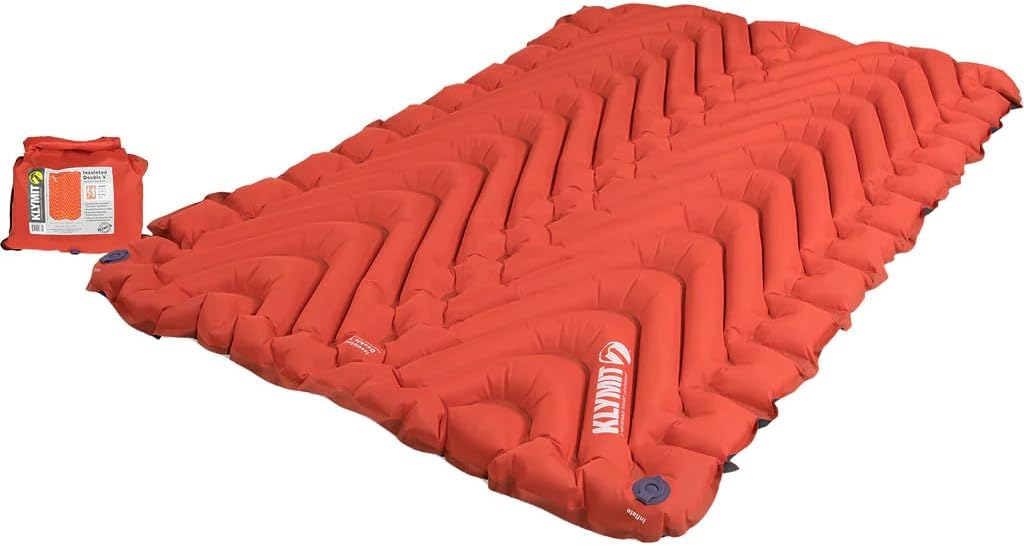
Best for side sleepers
KLYMIT Insulated Static V Inflatable Sleeping Pad, Thick Comfort Pad
Klymit
- R-value: Insulated (cold-weather capable)
- Weight: Moderate
- Thickness: Thick (cushioned)
- Packed size: Compact
- Type: Inflatable (insulated air)
- Width: Wide / generous
The Klymit Insulated Static V is a thicker, cushioned, insulated pad that keeps hips and shoulders off the ground. It is the best pick for side sleepers who need extra depth and support.
Last checked 2026-06-15
Best closed-cell foam: Therm-a-Rest Z Lite Original Closed-Cell Foam Camping & Backpacking Sleeping Pad

Best closed-cell foam
Therm-a-Rest Z Lite Original Closed-Cell Foam Camping & Backpacking Sleeping Pad
Therm-a-Rest
- R-value: ~2.0
- Weight: Light (~14 oz)
- Thickness: ~0.75 in
- Packed size: Folds (accordion, straps to pack)
- Type: Closed-cell foam
- Width: Regular
The Therm-a-Rest Z Lite is an indestructible accordion-fold foam pad that never punctures and doubles as a sit pad. It is the best closed-cell foam pick for durability and simplicity.
Last checked 2026-06-15
Best insulated winter pad: Therm-a-Rest NeoAir XTherm NXT Ultralight Winter Backpacking Sleeping Pad

Best insulated winter pad
Therm-a-Rest NeoAir XTherm NXT Ultralight Winter Backpacking Sleeping Pad
Therm-a-Rest
- R-value: 7.3
- Weight: Ultralight for warmth (~1 lb)
- Thickness: 3 in
- Packed size: Compact
- Type: Inflatable (insulated air)
- Width: Regular
The Therm-a-Rest NeoAir XTherm NXT delivers a 7.3 R-value for true four-season and winter use while staying light. It is the best insulated winter pad for cold-ground camping.
Last checked 2026-06-15
How to choose a backpacking sleeping pad
A sleeping pad does two jobs at once: it cushions you off the ground and, more importantly, it insulates you from it. The second job is the one beginners underrate, and it is the one that decides whether you sleep warm. The specs that matter, in order, are R-value first, then weight, then thickness, then type, then width and length. Read them as a set tied to the season you are packing for — spec-by-spec, the warmest pad is rarely the right buy, because warmth you do not need is weight and bulk you carry for nothing.
Hold one fact steady while you read: the pad is half of your sleep system, and on a cold night it is the half that fails first. A warm bag does almost nothing on its underside because your body crushes the insulation flat. The pad's R-value is what stands between you and the ground, so a 20°F bag on a 2.0 R-value pad still sleeps cold. Match the pad's R-value to your bag rating and your season, not to whichever pad feels plushest in the shop.
R-value: the spec that decides warmth
R-value measures resistance to heat flow — the higher the number, the more it slows your body heat draining into the ground. Modern pads are rated to the ASTM F3340 standard, which gives one comparable number across brands (before this standard, every maker used its own method, and the figures were not comparable). The clean part of R-value is that it is additive: stacking a 2.0 closed-cell foam pad under a 3.0 air pad gives you roughly 5.0, which is how many winter campers build a high-R setup cheaply and add puncture insurance at the same time.
As a rough seasonal guide drawn from the standard's intent: R-2 and under suits warm summer nights; R-2 to R-4 covers most three-season backpacking; and R-4.5 and up is for cold-weather and winter ground, where the surface may be near or below freezing. Spec-by-spec, a pad's R-value determines ground heat loss, so pairing a 20°F bag with a 2.0 R-value pad leaves a cold gap the bag cannot close, while the same bag on a 4.5+ pad sleeps to its rating. R-value is a lab figure; real-world warmth varies with the sleeper, the bag, the shelter and the conditions, and no number is a survival guarantee.
Type: air, self-inflating and closed-cell foam
There are three pad constructions, and each is a different point on the weight–durability–comfort triangle. Air pads are the lightest and most packable for their warmth and the most comfortable to lie on, often with internal reflective layers or baffles to lift R-value without adding weight; the trade-off is that they can puncture and need inflating. Self-inflating pads combine open-cell foam with air — open the valve and they draw in most of their air themselves. They are tougher and warmer for the bulk than they look, more comfortable than foam, but heavier and bulkier than air pads. Closed-cell foam pads are a solid sheet of foam: cheap, effectively indestructible, never fail and weigh little, but they are bulky (they strap to the outside of the pack) and firm to lie on.
Spec-by-spec, the choice follows the trip. Weight and pack space lead, dry conditions, willing to carry a repair kit → air pad. Comfort and durability lead, weight less critical → self-inflating. Budget, bombproof reliability, or a winter base layer to stack under an air pad → closed-cell foam. Many cold-weather backpackers run foam plus air together for the additive R-value and the puncture backup.
Weight and packed size
Weight and packed size are the carrying cost of the warmth you chose, and they trade against R-value and comfort. The lightest, smallest-packing warmth comes from an insulated air pad; the heaviest-for-warmth or bulkiest comes from self-inflating and foam. Read packed dimensions alongside weight — a light pad that does not roll small still costs pack volume, and a foam pad weighs little but rides outside the pack. Spec-by-spec, a three-season insulated air pad in the 12–18 oz range is the common backpacking sweet spot; ultralight pads drop under that with thinner builds or shorter lengths, and winter pads add weight for the higher R-value.
Thickness and comfort
Thickness is mostly a comfort spec, not a warmth spec — a thicker pad keeps your hips and shoulders off the ground, which matters more the harder you sleep and the more you turn. It does not directly set R-value (insulation method does that), though thicker air pads have more room for reflective baffling. Spec-by-spec, side sleepers and heavier sleepers should prioritise thickness — roughly 3 inches or more — because a thin pad lets pressure points bottom out, while back sleepers can sleep comfortably on less. Pair thickness with the R-value you need rather than treating them as the same thing.
Width, length and shape
Width and length decide whether you stay on the pad all night, which in turn decides whether you stay warm — an arm or hip sliding onto cold ground is a localised cold spot no bag rating fixes. Standard pads run about 20 inches wide; wide versions (25 inches and up) suit broad-shouldered, restless or side sleepers. Length is a weight lever: a regular length covers head to foot, while a short or three-quarter pad saves weight and packs smaller, with backpackers putting a pack or spare clothing under the lower legs. Tapered (mummy-cut) pads shave grams to match a mummy bag; rectangular pads give more room.
A note for side sleepers
Side sleepers put their full weight onto narrow hip and shoulder points, so a thin or hard pad bottoms out and disturbs sleep. Spec-by-spec, side sleepers should weight thickness (3+ inches) and a wider cut over outright lightness, and check that the R-value still meets the season — a plush but poorly insulated pad is comfortable and cold. The "best for side sleepers" slot on this page is anchored to exactly that combination: enough thickness and width to support pressure points without dropping below a usable R-value.
The pad is half the system — pair it with the bag
The pad and the bag are one purchase, not two. The pad blocks the ground; the bag blocks the air. Spec-by-spec, the cold-weather mismatch that ruins more nights than any other is a high-rated bag on a low-R pad — the bag is doing its job and the ground is still winning. Size them together: pick the R-value for your season, then pick a bag whose ISO Comfort rating matches the same overnight low. The best cold-weather sleeping bag guide covers the rating side for cold trips, the sleep-system matcher returns the required pad R-value and bag rating for your trip as one paired result, and a sleeping bag liner adds a few claimed degrees on top for cheap.
How air pads get their R-value
Two air pads can be the same thickness and weight yet have very different R-values, because warmth comes from how the pad traps and blocks heat, not from air alone — air on its own convects and is a poor insulator. Pads lift R-value with internal reflective films (metallised layers that bounce radiant heat back to you), baffled or stacked air chambers that limit convection, and sometimes synthetic or down fill inside the pad for the warmest builds. Spec-by-spec, this is why R-value, not thickness, is the warmth number to read: a thick uninsulated air pad can have a low R-value and sleep cold, while a thinner insulated pad rated R-4+ keeps you warm. Read the published ASTM F3340 R-value rather than guessing from thickness.
Common mistakes to avoid
The biggest mistake is treating the pad as a comfort item and ignoring its R-value, then blaming a cold night on the bag. Spec-by-spec, on cold ground the pad is usually the part that failed — a warm bag on a 2.0 R-value pad sleeps cold. The second mistake is buying for thickness alone: a plush, poorly insulated pad is comfortable and cold. The third is taking a summer pad onto shoulder-season or winter ground; ground temperature, not just air temperature, drives heat loss, and frozen ground demands R-4.5+. The fourth is carrying only a single fragile air pad on a remote winter trip with no backup — a puncture there is a serious problem, which is why foam-plus-air stacking earns its place.
Care, repair and longevity
Air and self-inflating pads last for years if looked after, and fail early if not. Inflate by pump sack or pump rather than by mouth where you can — moist breath inside the pad can, over time, breed mildew and add weight. Store self-inflating pads unrolled with the valve open so the foam keeps its loft, rather than tightly rolled for months. Carry the patch kit: most air-pad punctures are field-repairable, and finding the leak (soapy water or submersion at home) before a trip beats finding it at midnight. Closed-cell foam needs none of this — it is the set-and-forget option, and a reliable cold-weather base layer beneath an air pad. Spec-by-spec, a well-kept pad holds its R-value and comfort for many seasons.
How we frame the picks
Each slot is anchored to measurable specs. "Best overall" is the strongest balance of R-value, weight and comfort for three-season backpacking; "best budget" is the lowest price that still hits a usable R-value; "best for side sleepers" leads on thickness and width without dropping the R-value; "best closed-cell foam" leads on indestructible, never-fail reliability and stacking value; and "best insulated winter pad" leads on R-4.5+ warmth for cold ground. Comparisons here are spec aggregation from manufacturer details and ASTM F3340 R-value figures, not personal testing. Verified picks fill each slot once real product data is in.
Frequently asked questions
What R-value do I need in a backpacking sleeping pad?
As a rough guide, R-2 and under suits warm summer nights, R-2 to R-4 covers most 3-season trips, and R-4.5+ is for cold-weather and winter ground. R-value is an ASTM F3340 lab figure; real-world warmth varies with the sleeper, the bag, the shelter and the conditions, and no number is a survival guarantee. Verified picks land on this page once real product data is in.
Why does a cold pad sleep cold under a warm bag?
Lying down crushes the insulation beneath you, so the bag does little to stop heat draining into the cold ground. The pad's R-value is what blocks that conductive heat loss. A high-rated bag on a thin, low-R pad still sleeps cold — which is why we size the bag and pad as one system.
Air, self-inflating, or closed-cell foam?
Air pads are the lightest and most packable for their warmth but can puncture. Self-inflating pads are tougher and more comfortable but heavier and bulkier. Closed-cell foam is cheap, indestructible and never fails, at the cost of bulk and a firmer feel. It is a trade-off between weight, durability and comfort.