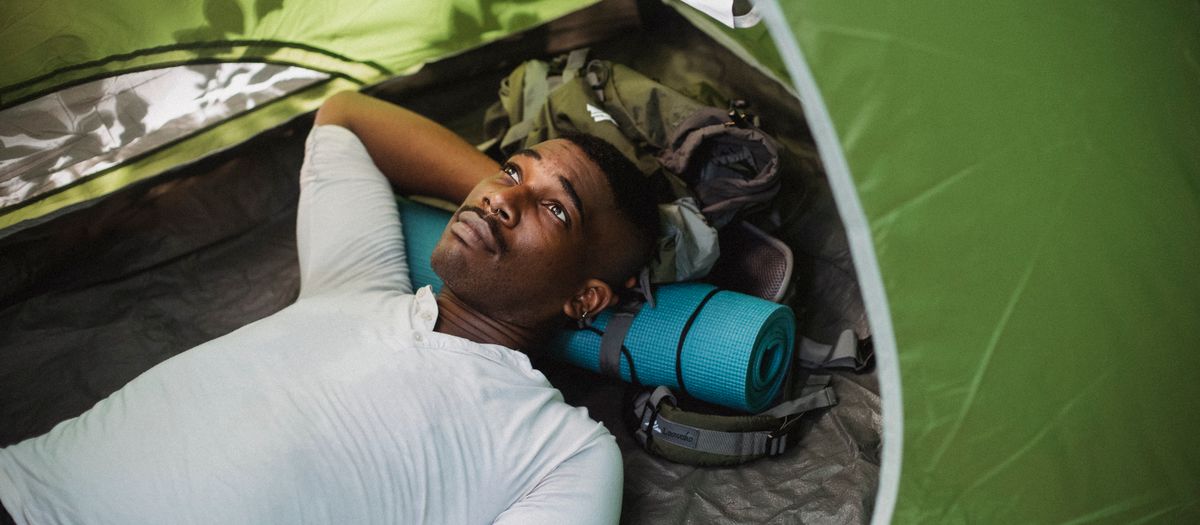
Once I’d learned the hard way that the pad is half my warmth (the cold-night story, if you missed it), I went down the rabbit hole on pad types. There are three main kinds, and they trade off warmth, weight, comfort and reliability in different ways. I’ve slept on all three. Here’s the honest rundown, plus a section for side sleepers, because I am one and we have specific needs.
Inflatable air pads
These are the pads you blow up (or pump up). Inside, they use baffles and often a layer of reflective film or light synthetic insulation to trap warm air and slow heat loss.
- Strengths: The best warmth-to-weight and the best packed size, by a clear margin. A modern insulated air pad can hit an R-value well into 3-season or even winter territory while weighing very little and packing down to the size of a water bottle. They’re also thick, so they’re comfortable on hard or uneven ground.
- Weaknesses: They can puncture. A leak in the field means a flat, cold night unless you carry a patch kit (I always do). They can also be a little crinkly and bouncy until you dial in the right firmness, and the cheapest uninsulated ones have a low R-value — fine for summer, a trap in the cold.
This is what I carry most of the time. The warmth-to-weight is just too good to pass up, and I manage the puncture risk with a patch kit and a thin foam pad as backup.
Self-inflating pads
These have an open-cell foam core inside an airtight shell. Open the valve and the foam expands and draws in air on its own; you top it off with a few breaths and close the valve.
- Strengths: A nice middle ground. The foam core adds insulation and means a small leak doesn’t leave you flat on the ground — you still have the foam. They’re comfortable and reliable, and often a bit cheaper than premium air pads.
- Weaknesses: Heavier and bulkier than a pure air pad of the same R-value. That foam core is warmth you can count on, but it costs grams and pack space.
I think of these as the dependable family-car option. If reliability and comfort matter more to you than shaving every gram — or you’ve had a bad experience with a leaking air pad — a self-inflating pad is a very sane choice.
Closed-cell foam pads
The classic accordion-fold or rolled foam mat. No air, nothing to inflate, nothing to puncture.
- Strengths: Indestructible. It cannot pop. It’s cheap, light, doubles as a sit pad, and works the instant you unroll it. There’s a real peace of mind in gear that simply cannot fail.
- Weaknesses: Thin and firm — much less comfortable, especially on hard ground — and the R-value of a single foam pad is modest (usually R-2 or so). Bulky too; it rides on the outside of your pack because it won’t compress.
Here’s the thing, though, and it’s one of my favourite tricks: R-values stack. A closed-cell foam pad under your air pad adds its R-value to the air pad’s, pushing a 3-season setup into winter range, and it gives you a leak-proof backup. So even though I rarely use foam alone, a thin foam pad is often in my kit as a stacking layer and insurance. More on that in layering a sleep system for shoulder season.
A note for side sleepers (like me)
Side sleeping changes the math. On your side, your hip and shoulder concentrate your body weight onto small contact points, which means:
- Thickness matters more. A thin pad lets your hip bottom out against the ground — cold and uncomfortable. Side sleepers generally want a thicker pad (think 3 inches or more) so the hip doesn’t punch through to the ground.
- Support matters more. Some pads feel like a bouncy balloon; a side sleeper sinks in and bottoms out anyway. Pads with good internal structure or baffling hold you up better.
- Width can matter. If your shoulders or arms hang off the edge onto cold ground, you lose warmth and comfort. A wide pad helps.
For all those reasons, side sleepers usually land on a thick insulated air pad — it delivers the cushion without the weight penalty a thick foam or self-inflating pad would carry. That’s the type I reach for, and it’s why I flag side-sleeper picks specifically in the best backpacking sleeping pads guide.
Living with an air pad (the failure mode worth planning for)
Since the insulated air pad is what I carry most, it’s worth being honest about its one real downside and how I manage it: the puncture. A leak isn’t just a comfort problem — a deflated pad has almost no R-value, so a flat pad is a cold pad, and a cold pad is a cold night. Over the years I’ve built a few habits that keep this from ruining trips:
- Carry a patch kit, always. A few grams of repair tape is the cheapest insurance in backpacking. I keep it where I can find it in the dark.
- Clear the ground before you pitch. Most punctures come from a sharp stick or stone you could have swept aside in ten seconds. A groundsheet or tent footprint adds a layer of defence.
- Inflate with a pump sack, not your mouth, on longer trips. Breath is warm and damp, and that moisture inside the pad can degrade the insulation over time and even grow mildew. A pump sack inflates with dry air.
- Carry a thin foam pad as backup on cold trips. It can’t go flat, it stacks for extra R-value, and if the air pad dies it’s the difference between a rough night and a dangerous one.
Manage those and the air pad’s warmth-to-weight advantage is yours with very little real risk.
How to choose, in order
Whatever the type, do it in this order: R-value for your season first (see R-value explained), then comfort and thickness for how you sleep, then weight and packed size, then price. Pick the type that fits your priorities — there’s no universally best one. And remember the pad is half a system: match its R-value to the bag’s Comfort rating for your overnight low. The sleep-system matcher hands you both numbers so the pair stays balanced.
These are general observations from my own trips, not lab measurements or a prescription for your specific gear. R-values are lab figures (ASTM F3340); real-world warmth varies with the sleeper, the pad, the shelter and the conditions, and no rating is a survival guarantee.